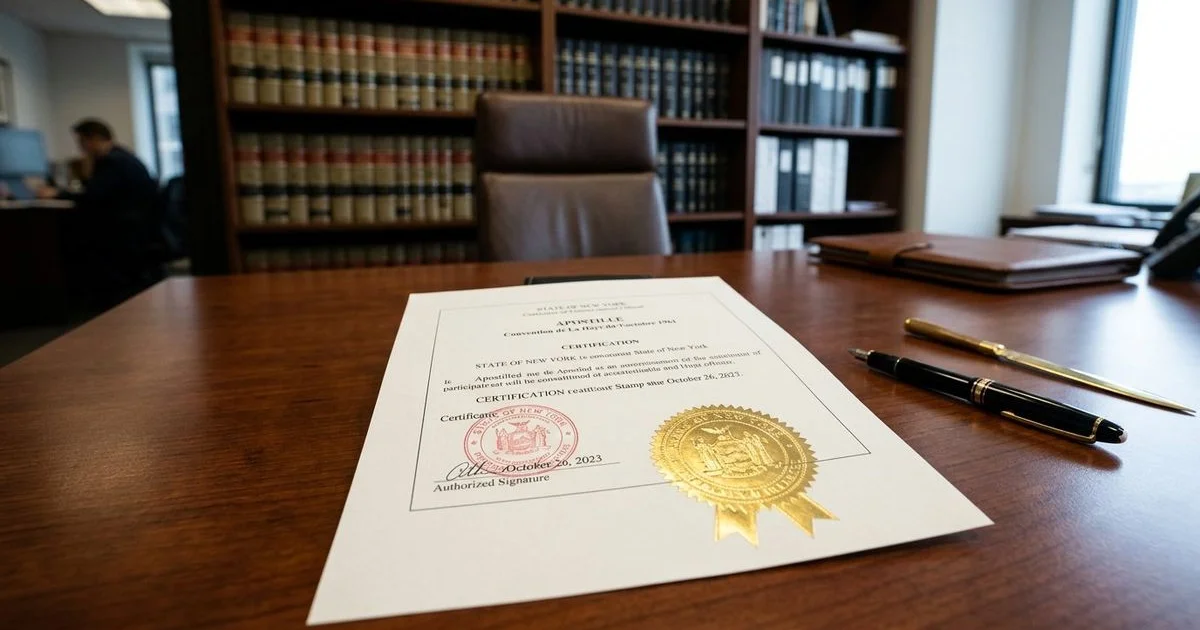
How to Get an Apostille in North Carolina: A Step-by-Step Guide
Complete guide to getting an apostille in NC. Learn the process, required documents, fees, and timeline for NC Secretary of State authentication.
Portia Burnett
Lead Notary & Co-Founder
Our team helps homeowners and business owners process international paperwork every single day. The verification requirements for foreign property purchases or corporate expansions often cause unexpected delays.
A minor notary error can quickly stall your plans.
We created this resource to simplify the entire authentication procedure for you. Here is your complete How to Get an Apostille in North Carolina: A Step-by-Step Guide.
What Is an Apostille?
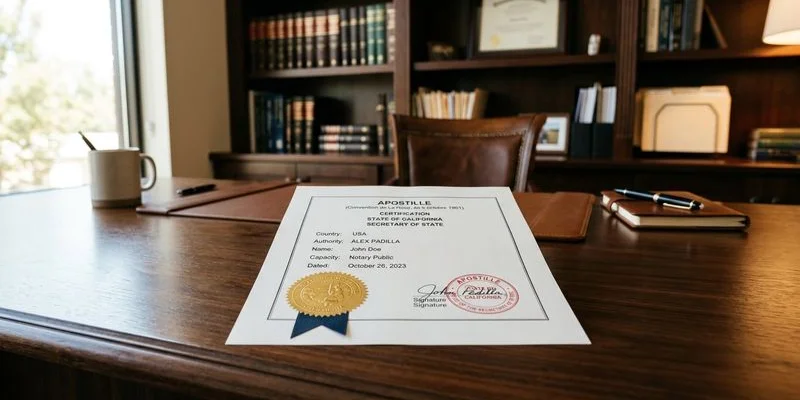
An apostille is a certificate issued by a designated government authority that authenticates the origin of a public document. In North Carolina, the office of Secretary of State Elaine F. Marshall issues these specific certificates. It acts as a verification stamp that tells a foreign country your paperwork is legitimate and properly notarized.
The apostille system was established by the Hague Convention of 1961 to simplify international document authentication. This treaty replaced a lengthy chain of consulate approvals with a single certificate, offering several benefits:
- Eliminates the need for embassy-level legalization in member countries.
- Provides a standardized format recognized globally.
- Speeds up cross-border legal and financial transactions.
Our professionals process these requests regularly for both corporate and personal needs. You will find that over 125 countries currently recognize this streamlined system. The network of participating nations continues to grow, with countries like Canada recently joining the convention in 2024.
When Do You Need an Apostille?
You need an apostille when a foreign country that is part of the Hague Convention requires proof that your document is authentic. Homeowners buying vacation properties abroad or business leaders opening international branches face this requirement frequently.
Common situations requiring an apostille include:
- International real estate: Buying or selling property overseas requires authenticated deeds, mortgage papers, and identity documents.
- Moving or working abroad: Employment contracts, background checks, and educational credentials need verification.
- Foreign marriage: Getting married in another country demands authenticated birth certificates, divorce decrees, or single status affidavits.
- International business: Corporate documents, certificates of good standing, and contracts used across borders must be verified.
- Studying abroad: Universities in other countries require authenticated transcripts and diplomas.
Our staff can help you determine the exact requirements for your destination country. For destinations outside the Hague Convention, you may need embassy legalization instead of a standard apostille. You can review our detailed comparison on apostille vs embassy legalization to see exactly which procedure applies to your documents.
Step-by-Step: Getting an Apostille in North Carolina
Step 1: Determine Which Documents Need an Apostille
Start by confirming exactly which documents the receiving country or institution requires. Business owners frequently need to verify their Articles of Organization or Certificates of Good Standing before signing international contracts.
Common documents that require authentication include:
- Birth, marriage, and death certificates
- Court orders and divorce decrees
- Educational diplomas and transcripts
- Corporate documents (articles of incorporation, certificates of good standing)
- FBI background checks and local criminal history records
- Notarized documents (powers of attorney, real estate deeds)
We always advise clients to ask the receiving party for explicit instructions. The foreign institution should specify if they need the original records, certified copies, or both types of paperwork. Taking the time to verify this detail prevents costly rejections later.
Step 2: Obtain Certified Copies or Original Documents
The North Carolina Secretary of State can only authenticate documents that originate within the state. This strict rule applies to both government-issued records and privately notarized paperwork.
Important sourcing guidelines:
- Vital records must be certified copies issued by the NC vital records office or the county register of deeds. As of 2026, the state charges $24 for the first copy and $15 for each additional copy of a vital record.
- Court documents must be certified copies directly from the issuing clerk of court.
- Notarized documents must be signed by a commissioned North Carolina notary public.
- Educational documents need to be issued by a North Carolina school or university.
Our apostille preparation service ensures your paperwork is correctly sourced and formatted before submission. The Secretary of State will immediately reject any documents that lack the proper certification or originate from outside the state. Gathering the correct local documents is the foundation of a successful application.
Step 3: Prepare Your Documents for Submission
Every page must meet strict formatting standards before it goes to the Secretary of State. A single missing signature or an illegible stamp will cause your application to be denied.
Check these specific requirements before mailing your package:
- The document must be an original or a recently certified copy.
- The notary’s commission must be active.
- The notary’s signature and seal must be completely clear. The state requires the seal to be photographically reproducible, meaning dark ink must be used.
- The document must be complete. Multi-page contracts cannot have any missing pages or blank fields.
We highly recommend reviewing every page for smudges or faded ink. If you need new signatures, Thrive Carolina’s mobile notary service can properly execute your documents right at your home or office. Getting the notarization right the first time saves weeks of waiting.
Step 4: Submit to the NC Secretary of State
North Carolina apostilles are issued by the Authentication Section of the Secretary of State’s office. You have two primary options for submitting your application.
In-Person Submission
You can bring your paperwork directly to the state office in Raleigh. Walk-in submissions are usually processed the same day or the very next business day.
- Address: 2 South Salisbury Street, Raleigh, NC 27601
- Hours: Monday through Friday, 8:00 AM to 5:00 PM
Mail Submission
Our team recommends using a rigid mailer to protect your documents from folding during transit. Include a formal cover letter detailing the countries of destination and the number of certificates requested. Provide a self-addressed, stamped return envelope using a trackable courier like FedEx or UPS. Enclose the exact fee payment.
Step 5: Pay the Required Fees
The North Carolina Secretary of State charges a flat fee of $10.00 per apostille certificate. You must include this payment with your submission package to avoid instant rejection.
Our team processes these payments using company checks, but individuals can use personal checks or money orders made payable to the “NC Secretary of State.” If you submit your documents in person, the office also accepts credit card payments. Multiple documents require separate fees for each attached certificate, meaning three business contracts will cost exactly $30 in state fees.
Pro Tip: Always verify your final document count before writing your check. Overpaying or underpaying will cause your entire application packet to be returned without processing.
Step 6: Receive Your Apostilled Documents
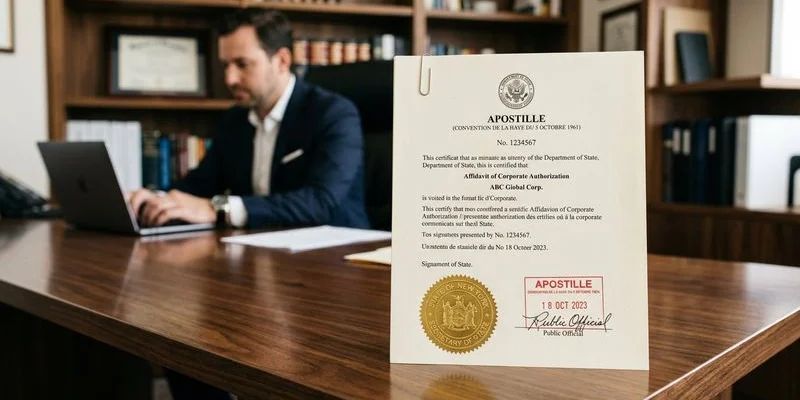
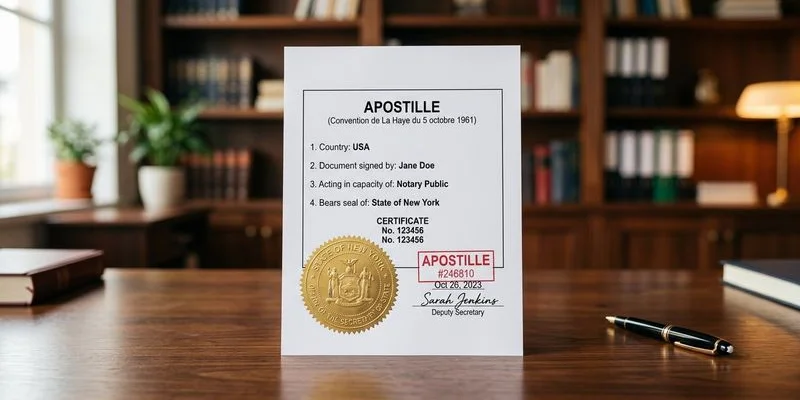
Once processed, the state permanently attaches a cover certificate to your original document. This specialized certificate contains a unique registration number and the official gold seal of North Carolina.
The authenticated document will display:
- The country of origin (United States of America)
- The name and capacity of the signing official or notary
- The date and place of authentication
- The Secretary of State’s signature
- The unique verification number
We must warn you never to remove the staple attaching the certificate to your document. Detaching the apostille cover page instantly invalidates the authentication. Foreign officials check for tampering, so keep the packet exactly as you receive it.
Common Reasons for Apostille Rejection
Mistakes during the preparation phase cause unnecessary delays and force you to pay return shipping fees. The authentication office strictly enforces all formatting and notary rules.
To avoid a rejected application, watch out for these frequent errors:
- Expired notary commission: The notary must be fully commissioned on the exact date of signing.
- Illegible notary seal: Faded stamps or smeared ink cannot be verified by the state.
- Wrong state of origin: A document notarized in South Carolina or Virginia cannot be authenticated in Raleigh.
- Uncertified vital records: Basic photocopies of birth or death certificates are never accepted.
- Removed staples: If a county clerk stapled a multi-page document, removing that staple breaks the document’s integrity.
Our specialists review every single page before sending anything to the state. Catching these minor errors early makes a massive difference in your approval timeline.
How Long Does the Process Take?
Processing times fluctuate based on the state’s current workload and your chosen submission method. You can find a detailed breakdown of these timelines in our guide on apostille processing times in North Carolina.
Our staff monitors these timelines closely to keep clients informed. In 2026, standard mail-in requests are currently taking up to 14 days to process due to high application volumes. Choosing the right delivery method depends entirely on your specific deadline.
| Submission Method | Estimated Processing Time (2026) |
|---|---|
| In-person delivery | Same day to 2 business days |
| By mail | 10 to 14 business days, plus courier transit time |
| Through a service provider | Expedited options vary based on daily courier schedule |
Let Thrive Carolina Handle Your Apostille
The authentication procedure is straightforward when your paperwork is flawless, but a single error can derail your international plans. Missing a critical detail often results in missed deadlines and lost application fees.
Our dedicated team provides comprehensive apostille services to completely eliminate this stress. Professional management of the detailed document review, proper notarization, and state submission ensures success.
You do not need to spend your day driving to Raleigh or worrying about rejected mail applications.
Contact us today to get your documents authenticated quickly and correctly.