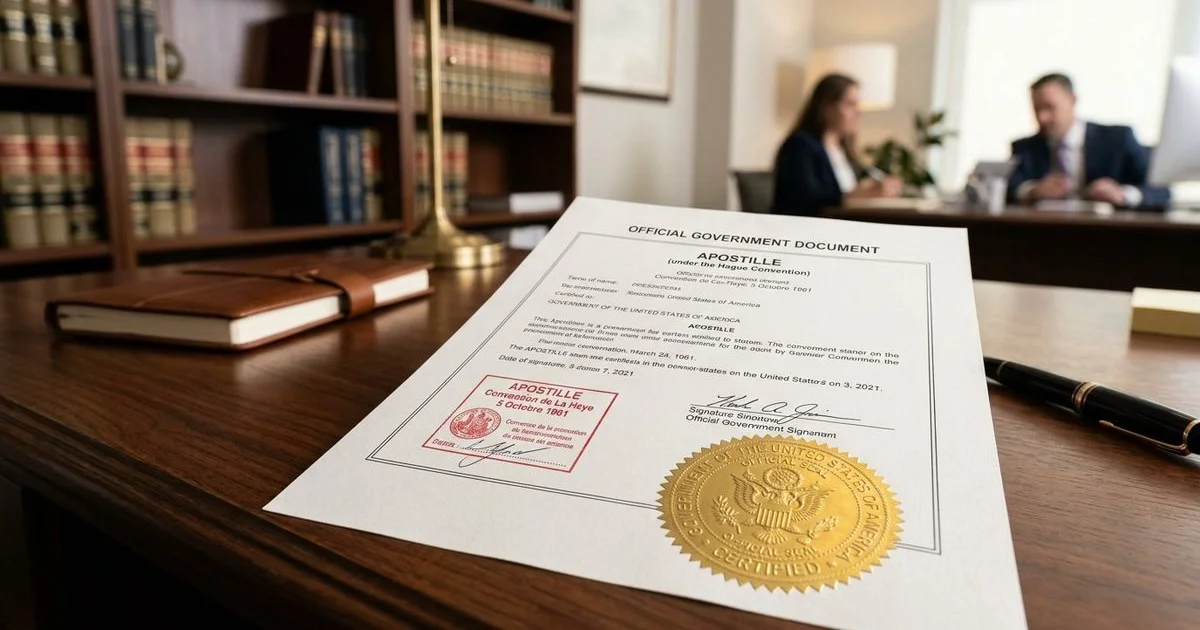
Apostille vs Embassy Legalization: Which Do You Need?
Understand the difference between an apostille and embassy legalization. Learn which countries accept apostilles and when you need embassy authentication.
Portia Burnett
As a professional service team handling international document authentication, we see business owners and homeowners constantly surprised by the strict paperwork rules for moving or expanding overseas.
The difference between a smooth transition and a month-long delay often comes down to one crucial question: Apostille vs Embassy Legalization: Which Do You Need?
You will either use a streamlined apostille or a multi-step embassy legalization process. Both verify that a document is authentic, but they require completely different timelines, costs, and steps.
“The destination country completely dictates your required authentication method, leaving no room for guesswork.”
We help clients at Thrive Carolina Mobile Notary and Apostille Services figure out the exact path for their situation every single day. Let’s look at the rules for these two processes and explore the practical ways to get your paperwork approved without delays.
The Fundamental Difference
The key distinction comes down to specific international treaties. Our team regularly explains to clients that the destination country completely dictates your required authentication method.
The Apostille Route
This is a streamlined, single-step authentication process recognized by countries participating in the Hague Apostille Convention. The Hague Conference on Private International Law (HCCH) formally adopted this treaty on October 5, 1961, to simplify cross-border paperwork. Over 120 nations currently participate in this agreement.
The Embassy Legalization Route
This multi-step authentication process is mandatory for countries that are not members of the Hague Convention. The procedure involves securing authentication at the state level, then the federal level, and finally at the specific destination country’s embassy or consulate.
In practical terms, an apostille is simpler, faster, and less expensive. The embassy route requires much more effort and money, but you cannot skip it if your destination country demands it.

How the Apostille Process Works
The apostille process is relatively straightforward, which is exactly what the Hague Convention intended back in 1961. We process these requests frequently and follow a clear set of steps to ensure approval.
- Prepare your document: Ensure it is an original or certified copy from the appropriate authority. If the document needs notarization, you must have it notarized by a commissioned North Carolina notary public.
- Submit to the NC Secretary of State: The Secretary of State’s Authentication Section reviews the document and issues an apostille certificate.
- Receive your apostilled document: The apostille is attached to your document, making it fully ready for international use.
That is the entire state-level process. One submission to one government office results in a universally recognizable certificate. For a detailed walkthrough, see our guide on how to get an apostille in North Carolina.
Insider Tips for Avoiding Rejection
Our experience shows that the North Carolina Secretary of State will quickly reject your application for simple oversights. A common error is failing to clearly indicate the destination country on the Apostille Request Form. Officials must know the destination because the final certificate format must match that specific country’s international requirements.
Missing notary stamps or expired notary commissions will also trigger an automatic rejection.
State vs. Federal Apostilles
While state documents go to Raleigh, federal documents like an FBI background check require a different path. These must go to the U.S. Department of State’s Office of Authentications in Washington, D.C. As of 2026, the federal office states a processing time of 5 weeks or more for mail-in requests.
- Typical timeline: 1 to 10 business days for state documents, depending on whether you submit in person or by mail. Federal documents take much longer.
- Typical cost: $10 per document at the NC Secretary of State, plus any standard notarization fees.
How Embassy Legalization Works
Embassy legalization, frequently called consular legalization, is a rigid multi-step chain of authentication. Each step in this specific sequence verifies the signature and seal of the previous one.
- Notarization: A commissioned notary public notarizes the document in the state where it will be authenticated.
- State Authentication: The Secretary of State authenticates the notary’s signature and commission. This step looks similar to getting an apostille but serves only as preparation for the federal level.
- Federal Authentication: The U.S. Department of State authenticates the Secretary of State’s signature. This happens at the Office of Authentications in Washington, D.C.
- Embassy or Consulate Legalization: The destination country’s embassy or consulate in the United States reviews all previous stamps. They then place their own final certificate or seal on the document.
Only after successfully completing all four steps is the document legally ready for use in the destination country.
Real-World Costs and Timelines
We advise clients to budget carefully for this route, as costs vary dramatically by country and document type. For example, if you need to legalize documents for the United Arab Emirates in 2026, personal documents might cost around $40 to $50 in embassy fees based on recent VFS Global data. Commercial business documents, like a Certificate of Incorporation, will cost over $600 just for the UAE Embassy fee alone, plus additional third-party processing fees.
- Typical timeline: 4 to 12 weeks depending on the embassy, the document type, and current federal backlogs.
- Typical cost: $50 to over $600 per document, factoring in state fees, federal fees, and specific embassy charges.
Which Countries Accept Apostilles?
The Hague Apostille Convention currently includes over 120 member countries. We frequently process paperwork for homeowners and business owners expanding into these specific regions.
- Europe: United Kingdom, Germany, France, Italy, Spain, Netherlands, Portugal, Greece, Poland, and virtually all European nations
- Asia: Japan, South Korea, India, Philippines, and mainland China
- North America: Mexico, and newly added Canada
- South America: Brazil, Argentina, Colombia, Peru, Chile
- Central America and Caribbean: Panama, Costa Rica, Dominican Republic
- Oceania: Australia, New Zealand
- Africa: South Africa, Morocco, Botswana, and Rwanda
Recent Additions to the Convention
The list of participating nations actively grows, which is great news for international business. Mainland China officially joined the convention in November 2023, eliminating their previously required multi-step embassy process for U.S. documents. Canada also implemented the apostille convention in January 2024, drastically simplifying cross-border real estate and business transactions for North American companies.
If your destination country appears on the official Hague Convention member list, an apostille is all you need.
Which Countries Require Embassy Legalization?
Certain notable countries remain completely outside the Hague Convention and strictly require full embassy legalization. Our team helps clients manage the lengthy paperwork for these specific destinations.
- Middle East: United Arab Emirates, Qatar, Kuwait, Saudi Arabia, Iraq, Iran
- Asia: Taiwan, Vietnam, Thailand, Indonesia, Malaysia
- Africa: Egypt, Nigeria, Kenya, Ethiopia, Ghana
Important note: Always verify the current membership status of your destination country before starting the authentication process. International agreements update regularly, and utilizing outdated procedural lists will cost you weeks of wasted time.

Apostille vs Embassy Legalization: Which Do You Need? A Side-by-Side Comparison
We use this table as a quick reference guide during client consultations. The stark difference in processing times is usually the biggest surprise for first-time applicants.
| Factor | Apostille | Embassy Legalization |
|---|---|---|
| Number of steps | 1 to 2 | 4 or more |
| Processing time | 1 to 10 business days (state level) | 4 to 12 weeks |
| Cost per document | $10 to $50 | $50 to $600+ |
| Accepted by | Hague Convention members (120+ countries) | Non-member countries |
| Issuing authority | State Secretary of State | Foreign embassy or consulate |
| Standardized format | Yes (uniform across all countries) | No (varies strictly by country) |
| U.S. Dept. of State required? | Only for federal documents | Yes, mandatory for all documents |
Common Mistakes to Avoid
Even small errors during the authentication process will force you to start completely over. We regularly step in to fix these exact issues for frustrated business owners.
Assuming All Countries Accept Apostilles
Not every country participates in the Hague Convention. You will waste valuable time and money if you obtain an apostille for a document going to a non-member country like the UAE or Vietnam. Always verify the destination country’s specific requirements on the official Hague Conference (HCCH) website first.
Getting the Wrong Type of Certified Copy
Both authentication processes require highly specific types of documents. A standard regular photocopy is never acceptable under any circumstances. Vital records, such as birth or death certificates, must be certified copies issued directly from the state’s Department of Health and Human Services or vital records office.
Court documents require a certification stamp directly from the clerk of court. Submitting the wrong type of copy adds weeks to your timeline.
Notarizing in the Wrong State
State authentication must explicitly come from the state where the document was originally notarized. If a notary public in North Carolina stamped your document, the NC Secretary of State handles the authentication. You must go through Virginia’s Secretary of State if the document was notarized in Virginia, even if your business operates primarily out of North Carolina.
Underestimating Embassy Processing Times
Embassy legalization timelines are notoriously unpredictable. The U.S. Department of State alone currently takes 5 weeks or more to process mail-in authentications before the document even reaches the foreign embassy. Individual embassies often experience severe backlogs during busy travel seasons or sudden staffing changes.
You must build significant extra padding into your schedule when dealing with non-member nations.
How Thrive Carolina Can Help
Managing the authentication process feels overwhelming, especially when you face strict international deadlines. We offer comprehensive apostille and authentication services at Thrive Carolina Mobile Notary and Apostille Services to eliminate the guesswork. This dedicated team covers every essential step:
- Document review: Identifying missing elements ensures your paperwork meets all strict state and federal requirements before submission.
- Notarization: Convenient signature verification happens through our commissioned North Carolina professionals via our mobile notary service.
- Apostille processing: Expedited submissions go directly through the NC Secretary of State.
- Embassy legalization guidance: Proper preparation and submission guarantee smooth processing for non-Hague Convention countries.
We handle the heavy lifting so you can focus entirely on your international business or relocation plans. Contact Thrive Carolina today to discuss your Apostille vs Embassy Legalization needs and receive a clear, actionable plan.